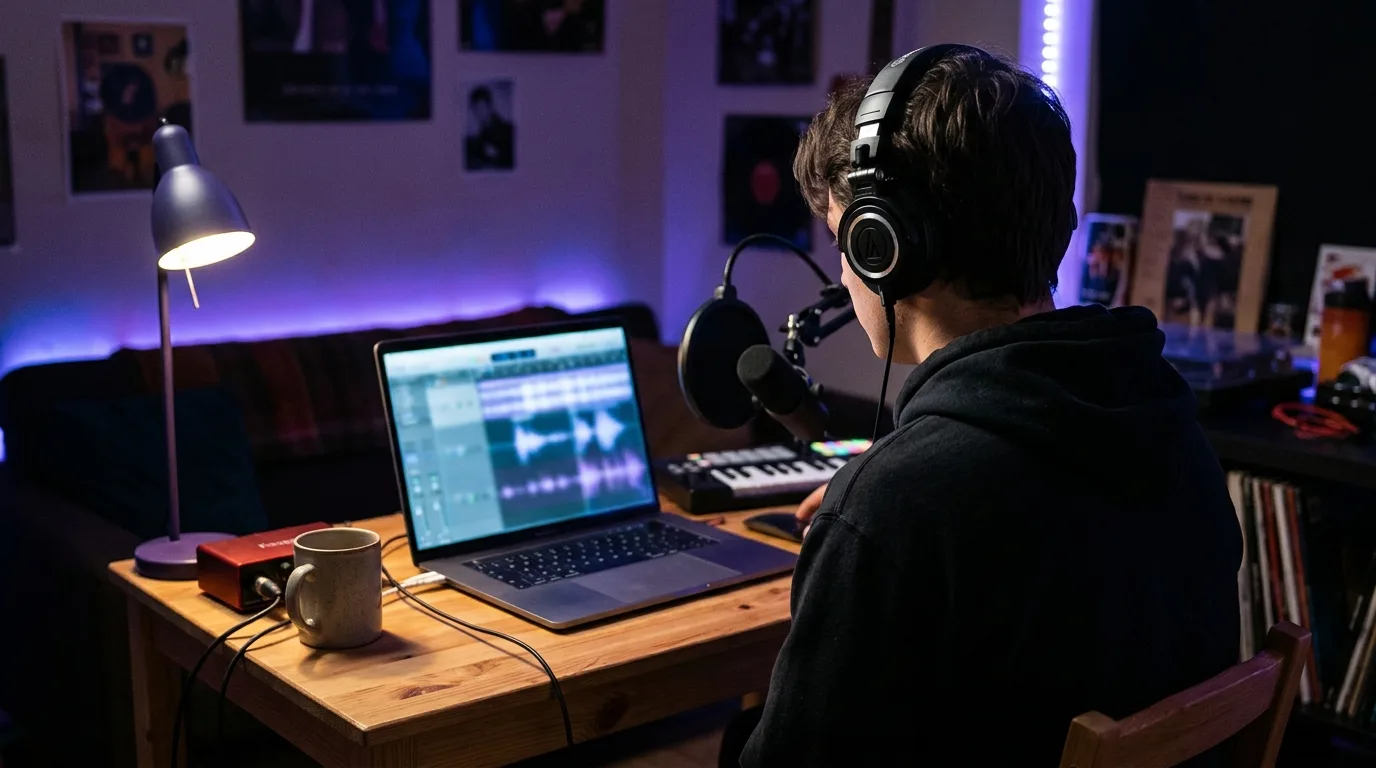
AI music works by turning your description and lyrics into audio: a text-to-music model creates the track and an AI singing voice performs the words. You can release it through a distributor, but you only own what you creatively control, and you must never copy a real singer's voice without permission.
How does AI music actually work?
You describe a song, and a model writes the sound. AI music tools are trained on huge amounts of audio, so they learn how genres, instruments, rhythms and voices fit together. You give them words like “slow Urdu love song, acoustic guitar, warm female voice” and they generate audio that matches.
Most AI music today is built from four parts working together:
- Lyrics. Written by you, or drafted by a language model and then edited by you.
- Music. A text-to-music model turns your description into a backing track — melody, chords, drums, mood.
- Vocals. An AI singing voice turns the lyrics and melody into a sung performance. Some tools do music and vocals in one step.
- Mixing and mastering. Software balances the levels and makes the track loud and clear enough for phones, speakers and streaming apps.
The honest part: the first result is rarely the final one. Good AI music comes from generating several versions, picking the best parts and fixing the rest — the same way a producer works, just much faster.
What do you need to make a song with AI?
Less than you think — but more than one button. You do not need a studio, a microphone or years of training. You do need a clear idea and some patience.
- A clear brief. Genre, mood, tempo, language and who the song is for. “Happy birthday song for a seven-year-old, playful, 30 seconds” beats “make a nice song”.
- Your own lyrics, ideally. They make the song personal, and — as you will see below — they matter for ownership.
- A generation tool or API. A consumer app for one-off songs, or a developer API if you want songs created inside your own website or app.
- Simple editing. Even free audio editors let you trim, fade and join the best takes.
- Time to listen. Play it on a phone speaker and in headphones. Weak spots show up fast.
If you only want a song for a party, a video or a gift, that is the whole list. Releasing it to the world needs a few more steps.
Can you release AI music on Spotify and other platforms?
Yes — if it is honest, original and not spam. Streaming platforms accept music made with AI tools, but they are getting much stricter about how it is labelled and used.
To release any song you usually go through a distributor, a service that delivers your track and its details to the streaming apps. Along the way you will need:
- Clean metadata. Song title, artist name, songwriter credits, genre, language and artwork. Mistakes here are the most common reason a release gets delayed.
- An ISRC. The International Standard Recording Code identifies a recording. According to the official ISRC structure, it is 12 characters made of a prefix code, a two-digit year and a designation code. Most distributors assign one for you.
- An AI disclosure. Spotify says it supports a new industry standard for AI disclosures in music credits, developed through DDEX, covering AI use in vocals, instrumentation or post-production.
Spam is the line you must not cross. Spotify has reported removing over 75 million spammy tracks in a single year, and says it is rolling out a filter that tags spam uploaders and stops recommending them. Uploading hundreds of near-identical AI tracks to farm streams is exactly what that system is built to catch.
Who owns a song made with AI music tools?
You own what you creatively control — not what the machine decides. That is the short version of the US Copyright Office's position, and it is a useful rule of thumb wherever you are.
In its report on AI and copyrightability, the Office said outputs can be protected “only where a human author has determined sufficient expressive elements”. It also said protection does not come from “the mere provision of prompts”.
What that means in practice:
- Typing a prompt is not authorship. A song generated entirely from a one-line description may have no copyright protection at all.
- Your own lyrics stay yours. Words you wrote are human work, even when an AI singing voice performs them.
- Your edits and arrangement count. The Office says human creative arrangement or modification of AI output can be protected, and using AI as a tool does not by itself block protection.
- Read the tool's terms. Each AI music service sets its own rules on commercial use and ownership of what it generates. Check them before you release or sell anything.
This is general information, not legal advice. Copyright rules differ between countries — if a song matters commercially, ask a lawyer in your market.
Can you use a famous singer's voice with AI?
No — not without their permission. Copying a real person's voice is the fastest way to get a track removed and, in more and more places, to break the law.
- Platforms ban it. Spotify's policy says vocal impersonation “is only allowed in music on Spotify when the impersonated artist has authorized the usage”.
- Laws are catching up. Tennessee's ELVIS Act added voice to the state's existing protection of a person's name, image and likeness, aimed squarely at AI voice cloning.
- Labelling is becoming law too. Under Article 50 of the EU AI Act, providers must mark AI-generated audio in a machine-readable way, and anyone publishing deepfake audio must disclose that it was artificially generated or manipulated.
The safe route is simple: use original AI voices that do not imitate anyone, or a voice you have clear written permission to use — including your own.
How do businesses use AI music?
Mostly for short, useful audio — not chart hits. The best business uses are the ones where speed and personalisation matter more than a famous name.
- Brand jingles and sound logos. Test ten directions in an afternoon before paying for a final version.
- Ads and social videos. Background tracks that fit the exact length and mood of each clip.
- Personalised songs inside apps. A birthday song with the customer's name, an anniversary song for a couple, a thank-you track for a loyal client.
- On-hold music and in-store audio. Original tracks you can use without licensing someone else's catalogue.
- Games and learning apps. Short loops and reward sounds that change with the player.
From our own work: we built Elena, a voice assistant that talks and sings personalised songs on request. The biggest lesson was cost control — live voice is far more expensive to run than text, so a song feature has to be designed around short, finished tracks rather than an open-ended live performance.
How do you add an AI song feature to a website or app?
The customer fills in a short form, and a finished song lands in their account. That is the experience to aim for. Behind it, a well-built song feature has five steps:
- Collect the details. Name, occasion, language, mood and length — using buttons and dropdowns, not a blank box.
- Write and check the lyrics. A language model drafts them from your template, and a filter checks for offensive words, misspelt names and real-artist references.
- Generate the audio. Lyrics and style go to a music generation API. The result is saved on your own storage, not left on someone else's server.
- Label and deliver. The track is tagged as AI-generated, saved in the customer's account and shared with a private link.
- Take payment and set limits. One payment per song or a monthly plan, with a daily cap so a single user cannot run up your bill.
We build this kind of feature into custom web apps, with checkout through our payment solutions and the workflow run by AI agents in the background.
When should you not use AI music?
When owning it, or meaning it, matters more than speed. AI music is a great tool, but it is the wrong tool in a few clear cases:
- Your main brand anthem. If the sound will represent you for years, you want clear ownership. Use AI to explore ideas, then have the final version made with real human authorship.
- Anything that copies a real artist. Sound-alike voices and “in the style of” clones invite takedowns and legal trouble.
- Stream farming. Mass-uploading tracks to collect royalties is treated as spam, and platforms are actively hunting it.
- Deeply personal moments. A wedding first dance or a memorial may deserve a human performance. Ask what the people involved would prefer.
Your AI music checklist
Before you create, release or sell an AI song, run through this list:
- Write the lyrics yourself, or heavily edit what the AI drafts.
- Use an original voice — never a real singer without written permission.
- Read the tool's terms on ownership and commercial use.
- Keep your versions and edits. They are your proof of human contribution.
- Disclose AI use when you release, and label AI audio clearly in your app.
- Release with clean metadata and one ISRC per recording through a distributor.
- Set cost limits before you put a song generator in front of customers.
Want songs created inside your own app or website? Tell us the idea and we will send a plan and a fixed quote. For the bigger picture, read how AI is changing the world.
Frequently asked questions
Is AI music legal?
Making music with AI tools is legal in most places. The problems start when you copy a real artist's voice without permission, break a tool's terms, or upload tracks as spam. Check local rules and the platform's policy before you release.
Can I copyright a song I made with AI?
In the US, only the parts a human creatively controls can be protected. Prompts alone are not enough, but your own lyrics, edits and arrangement can be. Rules vary by country, so get legal advice for commercial releases.
Do I have to say a song was made with AI?
Platforms increasingly ask for it, and Spotify supports AI disclosures in song credits. In the EU, AI-generated audio must be marked in a machine-readable way and deepfakes must be disclosed. Being open about it protects your account and your reputation.
Can AI sing in Urdu, Arabic or other languages?
Many AI singing voices handle several major languages, but quality varies a lot between languages and accents. Test pronunciation of names and local words carefully before you release or sell anything.
Can I earn money from AI music?
You can, as long as the tool's terms allow commercial use and the music is original. Selling personalised songs or using tracks in your own ads is far more reliable than hoping for streaming royalties.
How long does it take to build an AI song feature into an app?
A focused song feature with a form, lyric checks, generation, storage and payment is usually a matter of days to a few weeks, depending on your app. You get a fixed timeline and quote before work starts.
Sources
- US Copyright Office — Copyright and Artificial Intelligence, Part 2: Copyrightability
- Spotify — Strengthening AI protections for artists
- IFPI — ISRC structure
- Music Business Worldwide — ELVIS Act signed into law in Tennessee
- European Commission AI Act Service Desk — Article 50 transparency obligations
Build an AI song feature
Personalised songs inside your app or website — with lyric checks, payments and cost limits built in. Tell us the idea and get a fixed quote within one business day.
Get a quote →